What Is the Meaning of NGO? Understanding NGOs and Their Role in Society – Vallabh Sankalp Trust
Introduction
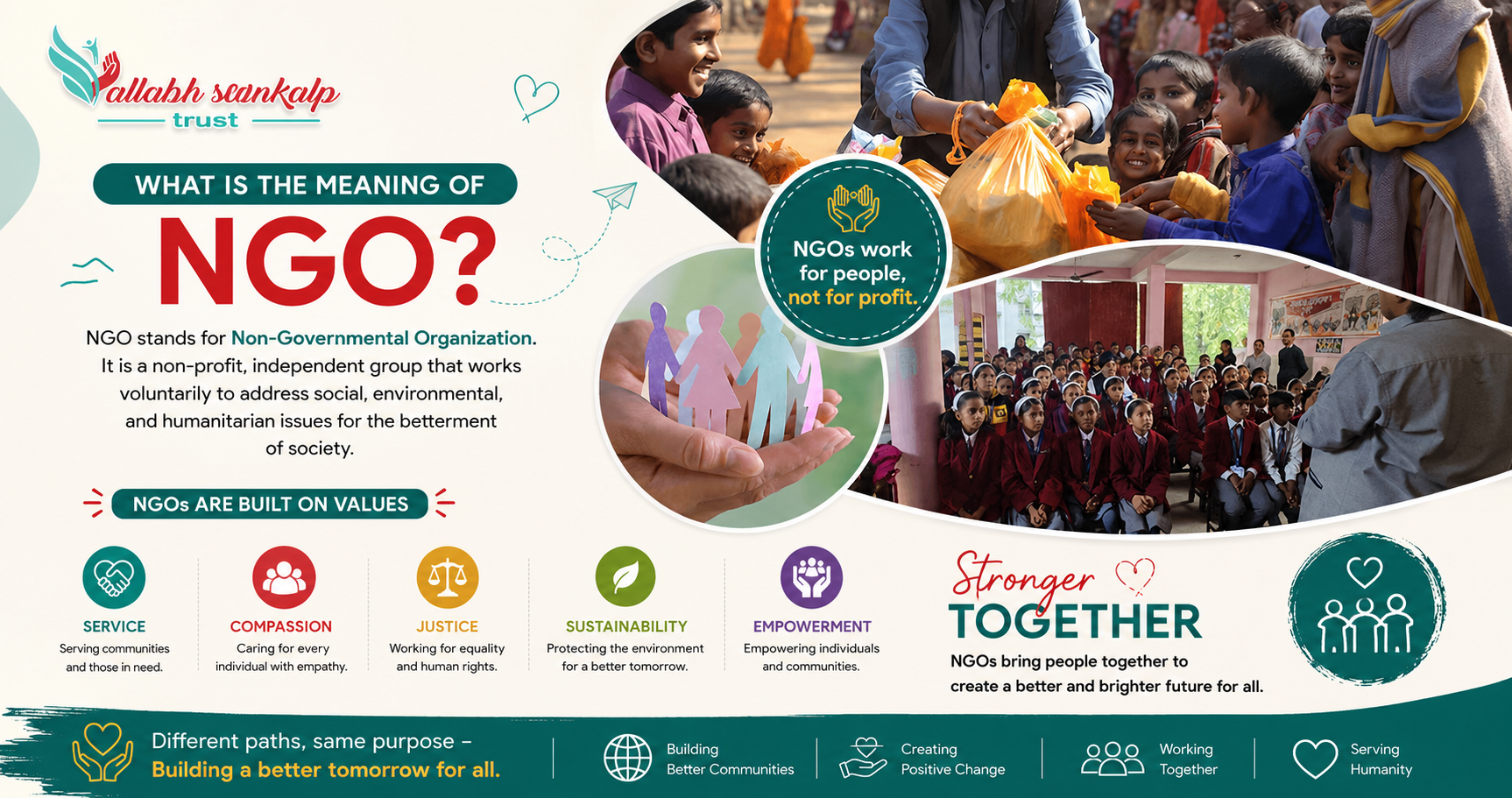
NGO is an acronym for Non-Governmental Organization. These organizations are citizens’ initiatives that operate without government interference. Their mission is to serve society through a wide range of activities such as education, health care, environmental protection, community development, advocacy of human rights, and provision of humanitarian assistance.
NGOs often serve as the backbone of social change by providing essential services, generating opportunities, and enabling people to improve their living standards.
As a charitable organization, we at Vallabh Sankalp Trust are of the opinion that helping others is a great way to change the world. By organizing focused welfare programs, NGOs are an indispensable part of social progress and the enhancement of community life.
What Does NGO Mean?
NGO is a Non-Profit Organization initiated by one or more persons to work for social, educational, environmental, healthcare, cultural, or humanitarian causes.
They differ from government agencies as they work independently and are largely financed through donations, grants, memberships, fundraising events, and the goodwill of volunteers.
Explanation of NGO
An NGO is a body that aims to serve people, communities, or the environment without making a profit as its primary aim.
Theirs is to raise social awareness, help disadvantaged groups, and play a role in the overall development of the society.
Distinctive Characteristics of an NGO
Autonomous Entity
NGOs have the freedom to act and work without facing interference from any government or governing body.
Non-Profit Corporation
NGOs’ sole aim is social service, and welfare of the community while profit or financial gain is the last.
Focus on Public
They aim at enhancing the well-being of individuals as well as communities.
Help from Volunteers
A lot of NGOs use volunteers time and skills as their major source of project implementation support.
Contribution to Society
NGOs operate in fields of primary education, health care, environmental protection, eradication of poverty and promotion of human rights, and many other areas.
Why Are NGOs Important?
NGOs have a significant role in the society especially when it comes to helping the personalities who are already disadvantaged or vulnerable.
Advantages of NGOs
- Work for the betterment of underserved communities
- Champion democratization of knowledge and increase literacy
- Increase people’s access to quality healthcare
- Help women and children to realize their full potentials
- Conservation of the Natural environment
- Offering help in cases of natural disasters and humanitarian emergencies
- Working for the protection and promotion of human rights
- Encouraging environmentally friendly practices and sustainable development
Community-based organizations like Vallabh Sankalp Trust keep taking steps for the social transformation through grass-root level programs and other such efforts.
Different Categories of NGOs
Number of NGOs can be divided according to their motives and working areas.
1. Charitable NGOs
These NGOs provide basic needs such as food, clothing, shelter, and education along with financial help to the poor.
2. Educational NGOs
These are mainly concerned with running literacy programs, scholarships, and enhancing educational facilities.
3. Healthcare NGOs
These NGOs provide healthcare support and spread health awareness by organizing campaigns and medical services.
4. Environmental NGOs
Such NGOs take steps to increase the environmental protection, sustainability, and promoting climate consciousness among people.
5. Human Rights NGOs
Human rights NGOs are committed to giving equal rights to everyone, the pursuit of justice and protection of people’s basic human rights.
6. Advocacy NGOs
These NGOs educate people about social issues and try to change public policy in favor of the socially disadvantaged groups.
7. Community-Based Organizations
Community-Based Organizations operate at the level of local community and through direct contact work to solve community problems and improve local quality of life.
8. International NGOs
International NGOs operate in several countries with a view to the achievement of goals on a global scale to the humanitarian needs of people.
Activities of Vallabh Sankalp Trust in Community Development
Vallabh Sankalp Trust is a non-profit organization that works to make societies a better place to live through different social welfare and development programs.
Major Programs
- Providing scholarships
- Developing communities
- Promoting health awareness
- Providing social welfare
- Supporting poor families
Through its meaningful social programs, the trust tries to enable communities, and help them grow sustainably.
Conclusion
Simply put, an NGO is a Non-Governmental Organization that does not rely on government and is aimed at bettering society and helping the needy. NGOs play a very important role in areas such as education, health, environment, human rights and development of local communities.
One such example is the Vallabh Sankalp Trust that proves how humanity, will and working together can change the lives of people as well as the community for the better. People can contribute to the work of NGOs in various ways like volunteering, donating or by spreading awareness to move towards a future that is fair to everyone.
Frequently Asked Questions (FAQs) About NGOs
1. What is an NGO?
🌟 NGO (Non-Governmental Organization) is a third sector entity which is neither a government nor a business, but an organization which is a non-profit, voluntary citizens’ group, which is organized at a local, national or international level to address issues in support of the public good.
2. What does NGO stand for?
🚀 NGO stands for Non-Governmental Organization.
3. What is the meaning of NGO?
📖 The meaning of NGO is an independent, non-profit organization that works for social welfare, community development, and public benefit.
4. Why do we need NGOs?
❤ The main passion of NGOs is to help society by working on the root causes of problems, empowering marginalized and vulnerable groups, and by bringing about positive changes in the communities.
5. Are NGOs exactly the same as charities?
✅ Often, NGO means non-profit organization, which is socially focused without the primary concern of making profits, is that correct?
6. What are the sources of NGO funding?
💰 NGOs have various methods to obtain funds such as donations by individuals or organizations, grants from the government, sponsorships, fundraising events, and memberships as well as support of the local community.
7. Is it possible for a person to establish an NGO?
🌱 It is possible if you have a strong mission and objectives, get registered legally, and are ready for a social service.
8. Define the primary function of an NGO?
🎯 The overall goal of an NGO is to assist in resolving social issues, promoting welfare of communities, and enhancing the quality of life.
9. Do NGOs work internationally?
🌍 A lot of NGOs not only stay within the borders of their home countries but work abroad and even globally for a wide range of and very serious issues as well as for the needs of humanity.
10. Name the different types of NGOs.
📚 Some of the most well-known NGO types are those supporting charities, those engaged in educational activities or promotion of health, those working for the preservation of the environment, those advocating human rights, and community-based NGOs.
11. In what ways do NGOs assist poor communities?
🤝 They offer various services, including access to education and healthcare, nutrition support, teaching the underprivileged how to develop new skills, and offering them ways of becoming independent.
12. What is the difference between an NGO and a government organization?
🏛 Government organizations are under the control of a state, whereas NGOs are independent entities working for the betterment of the society.
13. Do NGOs pay salaries?
💼 Absolutely. While some NGOs hire professional staff, they also give great importance to volunteers and their contribution for the cause.
14. How can I donate to an NGO?
💖 There are several ways for you to donate. You may choose to do it online or through fundraising events, bank transfers or simply by making a cash donation.
15. Are NGOs trustworthy?
🔍 The vast majority of registered NGOs will stand by their commitments to make their operations and finances transparent. However, it is always a good idea to do your own research before making a donation.
16. What sectors do NGOs work in?
🌟 NGOs contribute to education, healthcare, environmental protection, women empowerment, child welfare, and disaster relief among other sectors.
17. How do NGOs create social impact?
🚀 They work on a community level identifying the problems and needs first, then offering the solutions by educating and equipping the people to take control of their development.
18. What skills are useful for NGO work?
🛠 Being good at leading people, making friends and keeping in touch, working together, raising funds, managing projects, and having the skill of empathy are all great assets in NGO work.
19. How does Vallabh Sankalp Trust help society?
🌈 Vallabh Sankalp Trust enables the society by providing educational facilities, spreading healthcare awareness, and organizing community welfare and social development programs.
20. Why should I support an NGO?
❤✨ By assisting an NGO you not only aid in making possible living conditions better for the less fortunate but you also contribute to the making of a society that is more caring and united.