What is NGO? Understanding NGOs and Their Role in Society – Vallabh Sankalp Trust
Introduction
An NGO, or Non-Governmental Organization, is one of the main agents of social progress. They operate outside of government framework and their platforms include education, healthcare, environment, community development, human rights and humanitarian assistance.
Worldwide, NGOs are instrumental in meeting the unmet needs. They offer leverage to communities, provide vital services and motivate people to enjoy a good life.
At Vallabh Sankalp Trust, we are firm believers that even a small act of service has the power to change a life. Dedicated efforts by social welfare NGOs have a lasting impact on society.
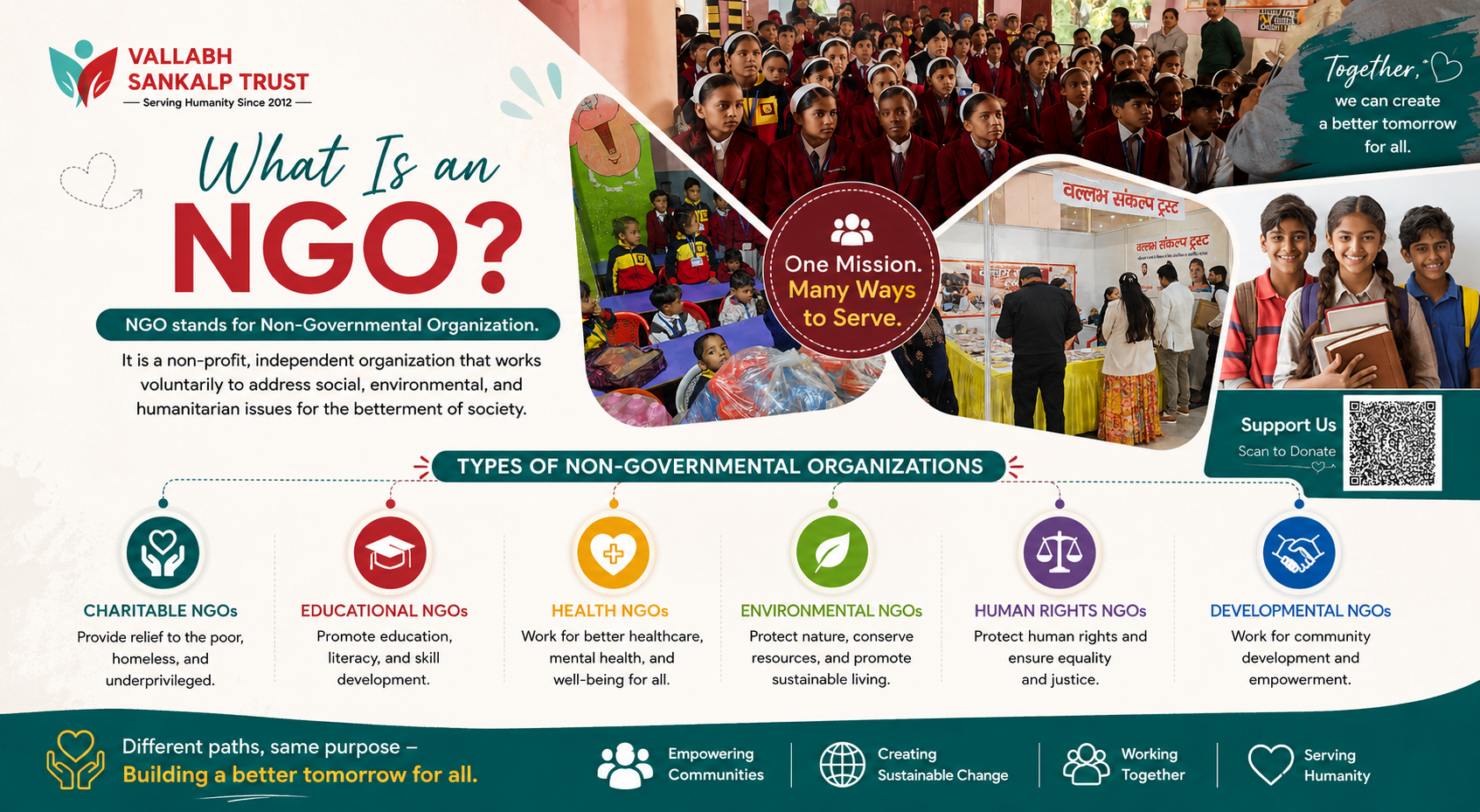
What Is an NGO?
An NGO (Non-Governmental Organization) is a nonprofit entity established by one or more persons, a group or a community to solve social, environment, education, health care, cultural, and humanitarian problems.
While governmental agencies are under political control, NGOs are relatively independent. They are mostly financed by donations, grants, memberships, fundraising, and volunteer support.
Simple Definition
An NGO is a group of individuals who work for the welfare of people, communities, or the environment without the primary aim of making profits.
Key Features of an NGO
Independent Organization
NGOs are separate entities and do not come under government supervision.
Non-Profit Nature
Social benefits are the first priority of NGOs and not making financial profits.
Community Focus
They work towards the betterment of people, societies and the environment, both locally and globally.
Volunteer Participation
Volunteers have always been instrumental in the growth and success of NGO.
Social Development
Through their activities, NGOs focus on education, healthcare, environmental awareness, and human rights.
Why Are NGOs Important?
NGOs are necessary accompaniments to governments in ensuring that no one is left behind in the process of development.
Benefits of NGOs
- Helping marginalized communities
- Spreading education and literacy
- Creating awareness about healthcare availability
- Providing support for women and children
- Ensuring environment protection
- Helping people affected by natural calamities
- Promoting human rights
- Encouraging sustainable development
NGOs such as Vallabh Sankalp Trust are examples of those who never abandon their work of bringing positive change through community-focused initiatives.
Types of NGOs
NGOs can be categorized into different types depending on their goals and the kinds of work they do.
1. Charitable NGOs
Address the basic needs of the poor such as food, clothing, shelter, education, and provide money for their expenses.
2. Educational NGOs
Concentrate on literacy, offering scholarships, and overall educational development.
3. Healthcare NGOs
Deal with providing medical help, promoting health awareness, and delivering healthcare services.
4. Environmental NGOs
Subject their efforts on environmental conservation and sustainability.
5. Human Rights NGOs
Stand for equality, law and order, and the safeguarding of human rights.
6. Advocacy NGOs
Spread knowledge and push for social change policies.
7. Community-Based Organizations
Engage with local people directly to address community level problems.
8. International NGOs
Such NGOs function in several countries and work on solving worldwide problems.
How Vallabh Sankalp Trust Contributes to Society
Vallabh Sankalp Trust is devoted to significantly changing society through different measures that help the community.
Areas of Focus
- Offering education
- Improving community
- Creating healthcare awareness
- Running social welfare schemes
- Helping poors and familes in need
It aims at community empowerment and is driven by the desire to create opportunities for continuous growth and development in a sustainable way.
Conclusion
NGOs have been regarded as one of the fundamental implementers of social change. They are one of the ways through which communities can struggle against the odds, enhance their living standards and create avenues for a better tomorrow. Be it through education, health, environment or humanitarian aid, NGOs are making a difference in society today and for the future.
Members of the Vallabh Sankalp Trust effectively illustrate that through commitment, love, and teamwork it is possible to change the lives of individuals and make communities stronger.
NGOs Frequently Asked Questions
1. What is an NGO?
🌟 A non-governmental organization (NGO) is a non-profit entity that seeks to make the world a better place by helping communities and solving social problems.
2. What does NGO stand for?
🚀 NGO is an acronym for Non-Governmental Organization. NGOs are groups of people that work independently to improve social welfare and development.
3. Why are NGOs important?
❤ Since they are the ones who provide assistance to communities most in need and make a difference in people’s lives.
4. Are NGOs non-profit organizations?
✅ Definitely! NGOs are firstly concerned with the results of their work and only secondly with their income. Basically, their primary objective is to give service rather than to make a profit.
5. How do NGOs get funding?
💰 They receive the essential funds for the implementation of their mission through the contributions of the public (donations), foundations, government agencies (grants), corporations (sponsorships), fundraising events, and community support.
6. Can anyone start an NGO?
🌱 Indeed, anyone can initiate the establishment of an NGO as long as they have a vision that specifies the equivalent societal issues, their understanding of how to what extent have the issues been addressed, legal registration, and motivation for social service.
7. What is the main purpose of an NGO?
🎯 To address the root causes of social problems and to make a lasting difference in the lives of individuals and communities.
8. Do NGOs work internationally?
🌍 Indeed, lots of NGOs go beyond their national borders and their work extends to people in other countries and even continents.
9. What are the different types of NGOs?
📚 NGOs can be classified based on their focus area such as charitable, educational, healthcare, environmental protection, human rights advocacy, etc..
10. How do NGOs help poor communities?
🤝 Apart from food and healthcare, NGOs also provide poor communities with education, skill vocational training, and the business opportunities necessary to foster their independence from aid dependency.
11. Can I volunteer with an NGO?
🙌 Without a doubt! Getting involved as a volunteer is one of the most rewarding avenues to cleave oneself to these paths of positive social changes.
12. What is the difference between an NGO and a government organization?
🏛 Government organizations run with government funds and are under the jurisdiction of the government.
NGOs, on the other hand, are independent of government control and serve the society.
13. Do NGOs pay salaries?
💼 Certainly. NGOs are moved by the goals of their mission but still have their own staff consisting of professionals and volunteers.
14. How can I donate to an NGO?
💖 There are a lot of ways to donate. You can go online, participate in fundraisers, send money through bank, or even give directly.
15. Are NGOs trustworthy?
🔍 Most registered NGOs follow transparency and accountability. Don’t forget to look at their credentials before donating.
16. What sectors do NGOs work in?
🌟 NGOs are present in education, healthcare, environment, women empowerment, child welfare, disaster relief, and many more sectors.
17. How do NGOs create social impact?
🚀 First they find out the problem. Then they put the solution in action. Finally, they raise people’s power to lead a better life.
18. What skills are useful for NGO work?
🛠 Working with NGOs needs you to be a leader, a good communicator, a team player, a fundraiser, a project manager, and very kind.
19. How does Vallabh Sankalp Trust help society?
🌈 The trust focuses on education, healthcare awareness, community welfare, and social development exposures.
20. Why should I support an NGO?
❤✨ Because every donation, whether large or small, contributes to building a world that is better, kinder, and more inclusive for all.